AI-Powered E-Learning Platform
Orion
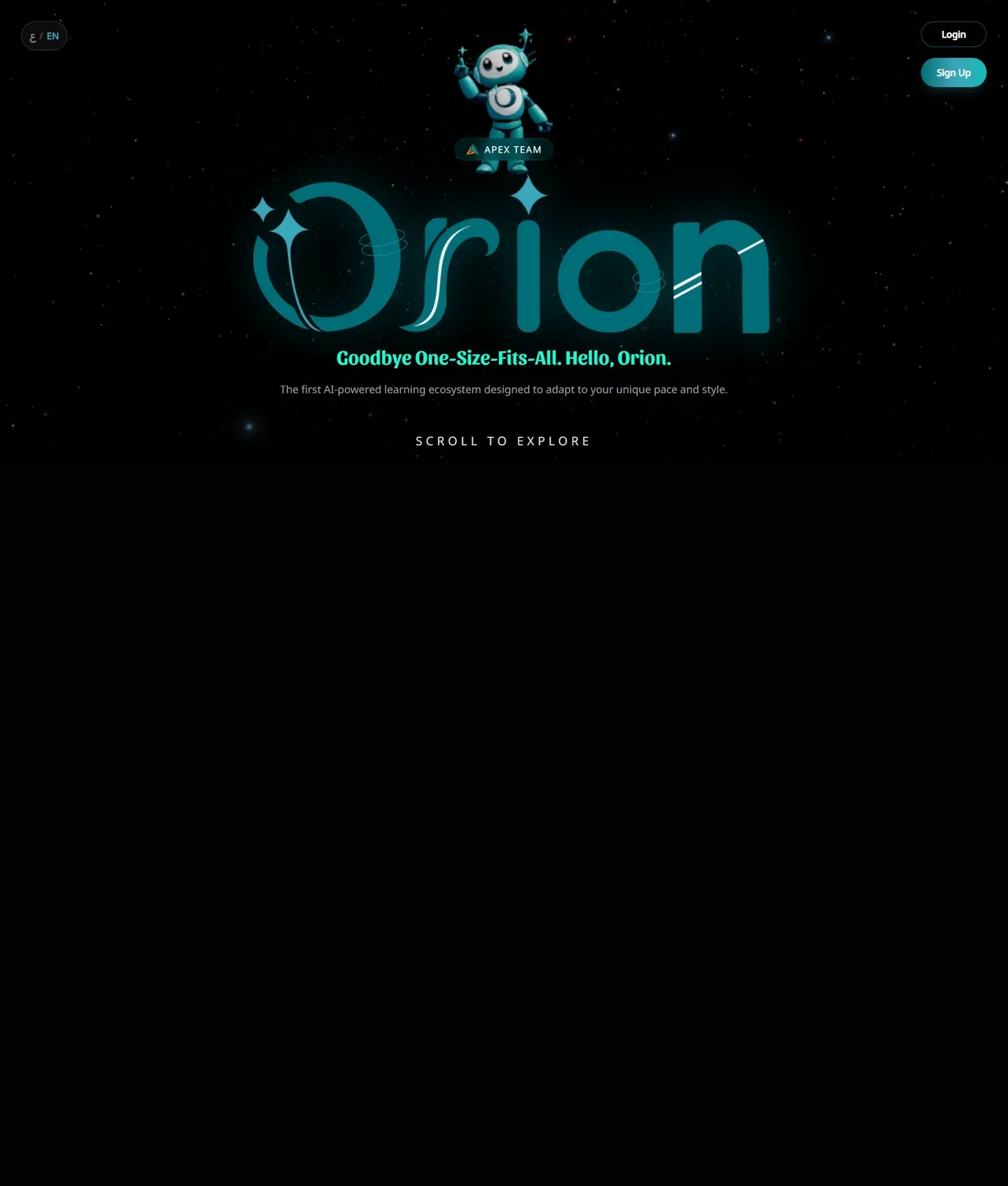
An AI-powered learning platform for Egyptian secondary students: personalised study plans, a 24/7 assistant trained on each teacher's own material, and web and mobile apps.
- Role
- Project Manager, Scrum Master & full-stack developer
- Team
- 7 people
- Timeline
- 9 months
- Type
- AI-Powered E-Learning Platform
- 33backend feature modules
- 45data models
- 7people on the team I led
- 3services live: web, API and AI
- ~$40monthly infrastructure cost for the MVP
Highlights
- Led a 7-person team as Project Manager and Scrum Master while owning system design.
- Modular-monolith backend: 33 feature modules and 45 data models on Node.js, Express 5 and TypeScript.
- Next.js 16 web portals and a React Native app for students, teachers and admins.
- AI service on FastAPI, Qdrant and Gemini 2.5 Flash, with a separate knowledge base per teacher.
On this page
The problem
Most online learning in Egypt treats every student the same. A secondary student who is strong in biology and stuck on physics gets the same videos, the same pace and the same tests as everyone else. Teachers see little of where their students struggle, parents see even less, and the lessons themselves are easy to record and pirate.
Orion started as our graduation project at the Faculty of Science, Alexandria University, with one goal: a platform that adapts to each student, gives teachers real insight, and protects their content.
What we built
For students: continuous academic analysis, study plans and tests generated from it, an assistant available around the clock, short lecture segments with surprise questions, and points, streaks, leaderboards and daily challenges to keep them coming back.
For teachers: question banks tagged by lesson, difficulty and skill, tests generated per student, and a dashboard showing which parts of a lecture get re-watched and which questions cause trouble.
For parents and admins: read-only progress tracking for parents, and user management, content oversight and system settings for administrators.
My role
I was the project manager and Scrum Master for a team of seven, and I also wrote backend and frontend code. That meant running two-week sprints, daily stand-ups, reviews and retrospectives, keeping the backlog honest against the deadline, and clearing whatever was blocking the team.
On the technical side I owned the system design: how the platform is split into modules, how the web, mobile and AI parts talk to each other, and where each piece is hosted.
Architecture
The backend is a modular monolith, not a set of microservices. With a small team and a fixed deadline, one deployable service with strict module boundaries gave us most of the structure of microservices without the operational cost.
Clients: Next.js 16 (React 19) portals for students, teachers and admins on Vercel, and a React Native app built with Expo for iOS and Android.
Backend: Node.js, Express 5 and TypeScript with 33 feature modules and 45 Mongoose models, covering identity, content, assessments, gamification, study plans, Q&A, notifications, fees and analytics.
Data: MongoDB Atlas as the primary store, Redis for session caching and token blacklisting, Cloudinary and S3 for media.
Delivery: the web app deploys from Git on Vercel, and the AI service ships as a Docker image through a three-stage GitHub Actions pipeline.
The AI service
The assistant runs as a separate Python service, built by the team's AI engineer on FastAPI. Each teacher has an isolated knowledge base in Qdrant, so a student asking about a physics lesson is answered from that teacher's own material and in that teacher's style, not from the open internet.
Retrieved passages are re-ranked and checked against the answer before it is returned, which cuts down on confident wrong answers. Gemini 2.5 Flash generates the response. Embeddings and re-ranking run locally on the server, a semantic cache answers repeated questions without calling the model, and daily token quotas are enforced per student.
Security
Teachers will not put their lessons on a platform that leaks them, so content protection was a requirement from day one.
Sessions use HttpOnly cookie tokens with a Redis blacklist, and each account is limited to two devices.
Every route is behind role-based access control, with rate limits that are strictest on sign-in.
Cloudflare provides the firewall, DDoS protection and TLS in front of the API.
Lecture playback includes screen-recording prevention.
Shipping on a student budget
The whole MVP runs on about $40 a month, covered by GitHub Student Developer Pack credits. Keeping embeddings, re-ranking and the vector database on our own server instead of paying for hosted versions is what made that possible.
Where it stands
The MVP is deployed: the web platform, the backend API and the AI service are all live. The same foundation is designed to carry the next steps, including more teachers, parent accounts, and additional curricula.
Built with
- Next.js 16
- React Native
- Node.js
- Express 5
- TypeScript
- MongoDB
- Redis
- FastAPI
- Qdrant
- Gemini 2.5 Flash
- Docker
- GitHub Actions
Building something similar?
I can help you plan it, build it, or lead the team that does.